
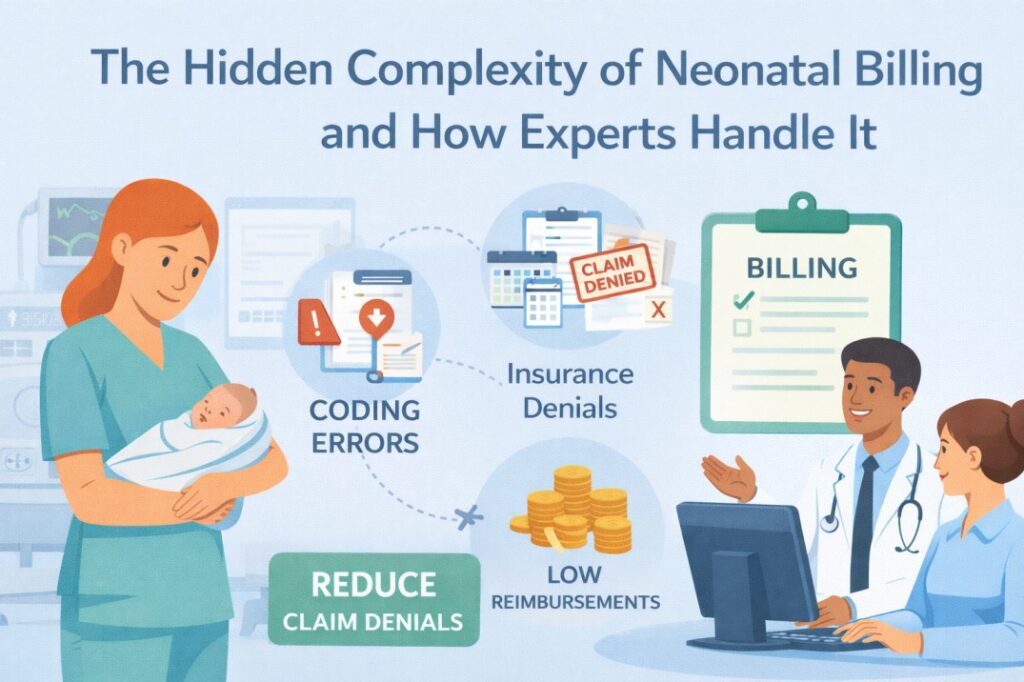

Neonatal care is one of the most specialized and resource-intensive areas of healthcare. Treating premature and critically ill newborns requires advanced technology, multidisciplinary teams, and round-the-clock monitoring. While the clinical side of neonatal care is highly complex, the billing side is often even more challenging. Neonatal billing involves intricate coding rules, payer-specific requirements, bundled services, and strict documentation standards. Many healthcare organizations underestimate this complexity, leading to delayed payments, denied claims, and lost revenue. Understanding why neonatal billing is so difficult and how experts manage it effectively is essential for maintaining financial stability.
Why Neonatal Billing Is More Complex Than Other Specialties
Neonatal billing is fundamentally different from standard inpatient or outpatient billing. Newborns, especially those in neonatal intensive care units, often require multiple services each day. These services may include respiratory support, nutritional management, diagnostic testing, and specialized procedures. Each service must be coded accurately and linked to the correct level of care.
Another layer of complexity comes from patient status changes. A neonate’s condition can change rapidly, moving from critical to stable or vice versa. Billing must reflect these changes accurately, including transitions between different levels of neonatal care. Failing to document and code these changes properly can result in underpayments or claim denials.
The Challenge of Time-Based and Daily Care Coding
Neonatal billing frequently relies on time-based and daily care codes rather than simple procedure based billing. Providers must document the intensity and duration of care delivered each day. Payers closely scrutinize these claims to ensure the billed level of care matches the documentation.
Even small documentation gaps can cause problems. For example, missing notes on physician involvement, unclear descriptions of medical decision-making, or inconsistent time tracking can trigger audits or payment delays. Experts understand how to align clinical documentation with billing requirements to support every billed service.
Frequent Coding Errors in Neonatal Claims
Coding errors are one of the most common reasons neonatal claims are denied or underpaid. These errors may include incorrect assignment of diagnosis codes, misuse of neonatal evaluation and management codes, or failure to apply appropriate modifiers. Because neonatal coding rules are highly specific, general billing staff may not be familiar with the nuances required for accuracy.
Experts who specialize in neonatal billing stay current with coding updates, payer policies, and regulatory changes. Their knowledge helps ensure that each claim reflects the full scope of care provided while remaining compliant with guidelines.
Payer Variability and Authorization Challenges
Insurance coverage for neonatal services varies widely between payers. Some insurers have strict authorization requirements, while others apply different reimbursement rules for neonatal intensive care. Medicaid programs, in particular, may have state-specific billing guidelines that add another layer of complexity.
Billing experts are skilled at navigating these differences. They verify benefits, manage authorizations, and tailor claims to meet payer-specific requirements. This proactive approach reduces the risk of denials and improves payment timelines.
Documentation Demands in Neonatal Care
Accurate documentation is the foundation of successful neonatal billing. Clinical notes must clearly explain the severity of the newborn’s condition, the medical necessity of services, and the provider’s role in care delivery. Because neonatal cases are often audited, documentation must withstand close review.
Experts work closely with clinical teams to improve documentation practices. They help providers understand what details are essential for billing support, such as daily assessments, care coordination notes, and clear justification for higher levels of care. This collaboration strengthens both compliance and revenue integrity.
Managing Bundled and Unbundled Services
Neonatal billing often involves bundled services, where multiple components of care are included in a single payment. Determining which services are bundled and which can be billed separately requires specialized knowledge. Incorrectly unbundling services can lead to compliance issues, while failing to bill allowable services can result in lost revenue.
Experienced neonatal billing professionals understand how to identify billable components without violating bundling rules. Their expertise ensures practices receive appropriate reimbursement while maintaining compliance with payer policies.
Denial Management in Neonatal Billing
Denials are common in neonatal billing due to the high cost and complexity of care. Common denial reasons include lack of medical necessity, missing documentation, or coding inconsistencies. Without a structured denial management process, practices may struggle to recover lost revenue.
Experts implement systematic denial tracking and appeals processes. They analyze denial trends, address root causes, and submit strong appeals supported by clinical documentation. Over time, this approach reduces denial rates and improves overall revenue performance.
How Technology Supports Neonatal Billing Accuracy
Advanced billing technology plays an important role in managing neonatal claims. Specialized billing software can help track daily services, flag documentation gaps, and ensure coding accuracy. However, technology alone is not enough.
Billing experts know how to leverage technology effectively. They use reporting tools to monitor key performance indicators, identify revenue leaks, and ensure claims move smoothly through the billing cycle. When combined with human expertise, technology becomes a powerful asset rather than a risk.
The Value of Specialized Neonatal Billing Expertise
Given the complexity of neonatal billing, many healthcare organizations turn to specialists who focus exclusively on this area. These experts bring deep knowledge of neonatal coding, payer rules, and compliance standards. Their involvement reduces administrative burden on clinical staff and allows providers to focus on patient care.
Specialized billing support also improves financial predictability. Accurate claims, faster reimbursements, and reduced denials help organizations manage cash flow more effectively while minimizing compliance risks.
Conclusion
Neonatal billing is one of the most challenging areas of healthcare revenue management. The combination of intensive care, time-based coding, strict documentation requirements, and payer variability makes it difficult for general billing teams to manage effectively. Without expert oversight, practices risk revenue loss, audits, and operational inefficiencies.
By relying on neonatal billing specialists, healthcare organizations can navigate these complexities with confidence. Expert handling ensures accurate coding, strong documentation, effective denial management, and timely reimbursements. In an environment where both patient outcomes and financial sustainability matter, expert neonatal billing support is not just helpful; it is essential.
