
In today’s fast-paced digital world, organizations need smarter and more secure ways to manage identification and access control. RFID identity cards have become a popular choice for schools, offices, hospitals, events, and corporate environments. These cards combine convenience, security, and efficiency, making them an essential part of modern identification systems.
What Is an RFID Identity Card?
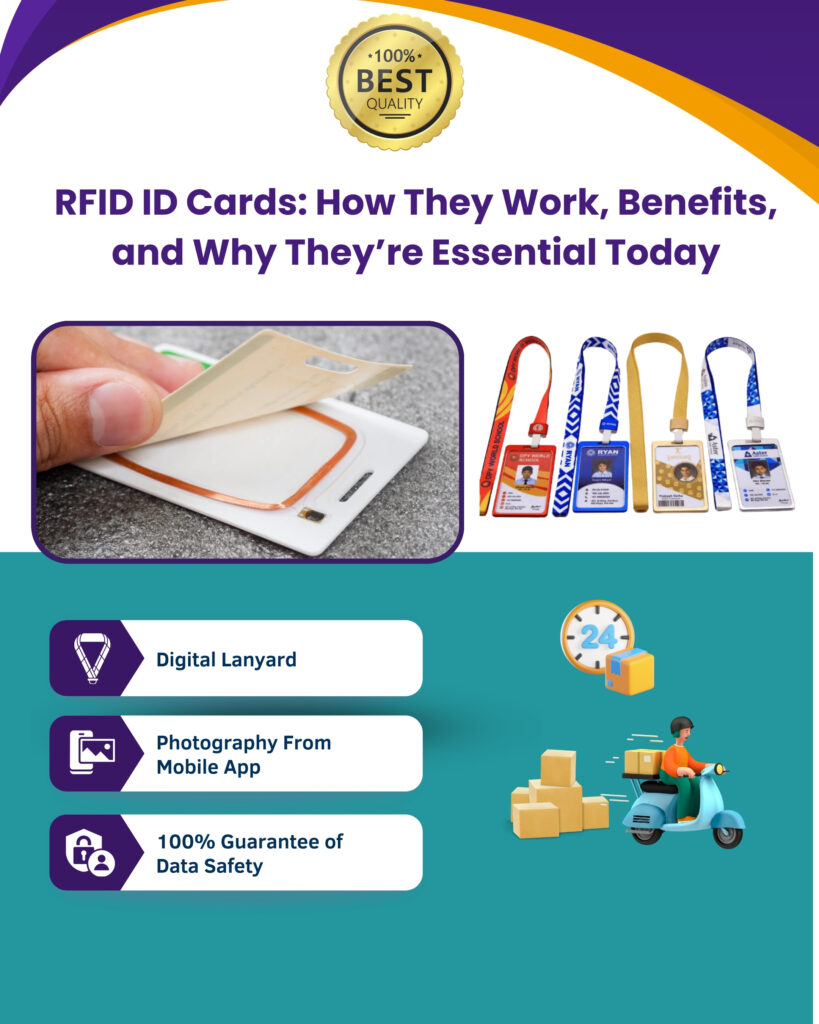
An RFID (Radio Frequency Identification) identity card is a smart card embedded with a small chip and antenna. This chip stores data that can be read wirelessly using an RFID reader. Unlike traditional ID cards that require physical contact or manual checking, RFID cards allow quick and contactless identification.
RFID identity cards are commonly used for employee attendance, access control, visitor management, cashless payments, and student identification.
How RFID Identity Cards Work
RFID cards communicate with readers using radio waves. When the card comes within range of an RFID reader, the reader scans the card’s chip and verifies the stored information. Based on this data, the system grants or denies access. This process is fast, accurate, and reduces human error.
There are mainly three types of RFID frequencies:
Low Frequency (LF) – Used for basic access control
High Frequency (HF) – Common in ID cards, libraries, and payment systems
Ultra-High Frequency (UHF) – Used for long-range tracking and logistics
Key Benefits of RFID Identity Cards
RFID identity cards offer several advantages over traditional ID cards:
Enhanced Security:
RFID cards are difficult to duplicate and can be encrypted, reducing the risk of unauthorized access.
Contactless Convenience:
Users only need to tap or bring the card close to a reader, making entry quick and hygienic.
Accurate Attendance Tracking:
RFID systems automatically record entry and exit times, improving attendance management.
Durable and Long-Lasting:
Most RFID cards are made from PVC, making them water-resistant and durable.
Scalable Solution:
RFID systems can easily be upgraded or expanded as an organization grows.
Common Uses of RFID Identity Cards
RFID identity cards are widely used across various industries, including:
Corporate offices for employee access and attendance
Schools and colleges for student ID and library management
Hospitals for staff and patient identification
Events and conferences for entry management
Residential societies for secure access control
RFID Identity Cards vs Traditional ID Cards
Traditional ID cards rely on visual verification, which can be time-consuming and less secure. RFID identity cards, on the other hand, automate identification and provide better security, faster access, and detailed digital records. This makes RFID cards a smarter choice for organizations that prioritize efficiency and safety.
Conclusion
RFID identity cards are transforming the way organizations handle identification and access control. With benefits like enhanced security, contactless operation, and accurate data tracking, they are an ideal solution for modern workplaces and institutions. Investing in RFID identity cards not only improves operational efficiency but also ensures a safer and more organized environment.