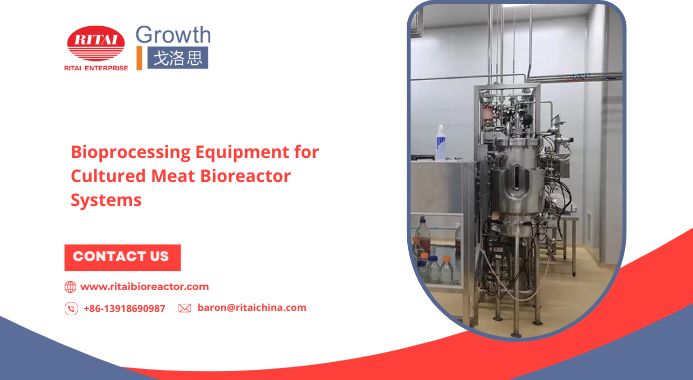

Most discussions around cultured meat focus on policy, sustainability claims, or future market size. Inside production facilities, the conversation is much simpler. Can the system run consistently, and can it run again tomorrow without surprises? That answer depends less on cell science and more on bioprocessing equipment doing its job quietly and predictably.
At the center of every setup is the cultured meat bioreactor, but the real performance comes from how well it works with the surrounding hardware—media preparation, gas delivery, control systems, and downstream handling. If one piece underperforms, the whole process feels it.
Equipment Consistency Is What Makes Cultured Meat Viable
Cells are sensitive. That’s not news. What’s often underestimated is how small equipment variations show up as biological problems later. A slight change in mixing behavior or oxygen delivery can alter growth rates or differentiation timing.
In pharmaceutical bioprocessing, losses hurt budgets. In cultured meat production, they stop progress altogether. Batches aren’t just expensive; they represent weeks of lost iteration time. This is why experienced teams treat bioprocessing equipment decisions as core strategy, not procurement tasks.
What a Cultured Meat Bioreactor Actually Does
A cultured meat bioreactor is less about volume and more about balance. Cells need steady access to nutrients and oxygen without being exposed to damaging forces. Unlike microbial systems, you can’t simply increase agitation or airflow to solve a bottleneck.
Most current systems are adapted from animal cell culture, including:
-
Stirred tanks with low-shear impellers
-
Perfusion setups for continuous nutrient exchange
-
Microcarrier-based reactors for anchorage-dependent cells
Each approach changes how the rest of the equipment must behave. There is no universal design that fits every cell type or production goal.
Media Preparation Equipment Sets the Baseline
Media formulation gets a lot of attention, but preparation is where problems usually start. Large-scale mixing needs accuracy and repeatability, not just capacity.
Common issues show up when:
-
Powders don’t dissolve evenly
-
Supplements settle during transfer
-
Sterility breaks during long mixing cycles
Well-designed bioprocessing equipment avoids these problems through controlled mixing speeds, automated dosing, and inline filtration. Once media quality drifts, downstream correction is nearly impossible.
Bioreactor Design and Agitation Choices
The bioreactor vessel defines what’s realistic at scale. Early-stage work often relies on glass systems, but those don’t translate cleanly to production volumes.
Manufacturers like Ritai Bioreactor focus on vessels that support scale transition without redesigning the entire process. Key design priorities include:
-
Impeller geometry that minimizes shear
-
Uniform mixing across different fill volumes
-
Compatibility with sensor and control upgrades
Agitation isn’t about moving faster. It’s about moving evenly.
Oxygen Delivery Is the Quiet Limiting Factor
Oxygen transfer is where many cultured meat systems struggle. Animal cells demand consistent oxygen but react poorly to turbulence.
To manage this, modern setups rely on:
-
Fine bubble sparging systems
-
Membrane-based oxygenation
-
Tight control of CO₂ removal
These systems don’t attract attention when they work. They only get noticed when growth slows unexpectedly.
Temperature and pH Control Can’t Drift
Temperature and pH tolerances are narrow. Even small fluctuations affect metabolism and differentiation.
Production-ready bioprocessing equipment uses:
-
Fast-response jacketed vessels
-
Inline probes designed for long runs
-
Automated correction loops rather than manual adjustment
Once systems rely on operator intervention, scaling becomes fragile.
Downstream Handling Requires a Different Mindset
Cultured meat isn’t purified like a drug compound. The cells are the product. That changes everything downstream.
Equipment here must:
-
Separate cells gently
-
Remove spent media efficiently
-
Prepare biomass for structuring or further processing
Many early failures come from using lab-scale harvesting tools that simply don’t translate to production volumes.
Single-Use and Stainless Systems Both Have a Place
There’s no universal answer here. Single-use systems reduce cleaning time and speed iteration. Stainless steel systems win on durability and long-term cost.
Most serious producers end up with a hybrid model. Suppliers such as Ritai Bioreactor design platforms flexible enough to support both, which reduces redesign cycles as production scales.
Automation Is No Longer Optional
Manual processes don’t survive scale. Cultured meat production generates constant streams of data, and ignoring them costs time and money.
Integrated bioprocessing equipment now includes:
-
Real-time metabolic monitoring
-
Automated feeding based on demand
-
Full batch data logging
This level of control isn’t about convenience. It’s about credibility with partners, investors, and regulators.
Scaling Is Where Equipment Choices Pay Off
Scale-up exposes assumptions. Mixing patterns change. Oxygen transfer behaves differently. Heat distribution becomes uneven.
Teams that succeed usually invest early in equipment that supports scale-down testing. Working with suppliers like Ritai Bioreactor allows processes to be validated at small scale under conditions that actually reflect commercial reality.
Regulatory Expectations Are Built Into Equipment
Cultured meat sits between food and biotech. Equipment must satisfy both.
That means:
-
Food-grade materials
-
Traceable components
-
Documented process control
Production-grade bioprocessing equipment shortens approval timelines because compliance is built in, not added later.
Cost Pressure Drives Engineering Discipline
Media costs, energy use, and downtime all tie back to equipment efficiency.
Practical cost control comes from:
-
Energy-efficient agitation
-
Reduced cleaning cycles
-
Faster turnaround between batches
These gains don’t come from biology alone. They come from engineering choices.
Closing Perspective
Cultured meat doesn’t fail because of lack of vision. It fails when systems don’t behave the same way twice. Bioprocessing equipment determines whether a process stays stable or slowly drifts out of control. The cultured meat Bio Reactor may be the centerpiece, but it only performs as well as the ecosystem around it.
Teams that treat equipment as a strategic asset, not an afterthought, move faster and make fewer mistakes. In this field, that difference matters.