
You know the feeling. You’re at a pub quiz or playing a trivia game on your phone. A question is asked, one that seems to stump everyone else. But in the recesses of your mind, a memory flickers. You dig for it, hold your breath, and then declare the answer with tentative confidence. A moment later, the Quizmaster confirms it: you were right.
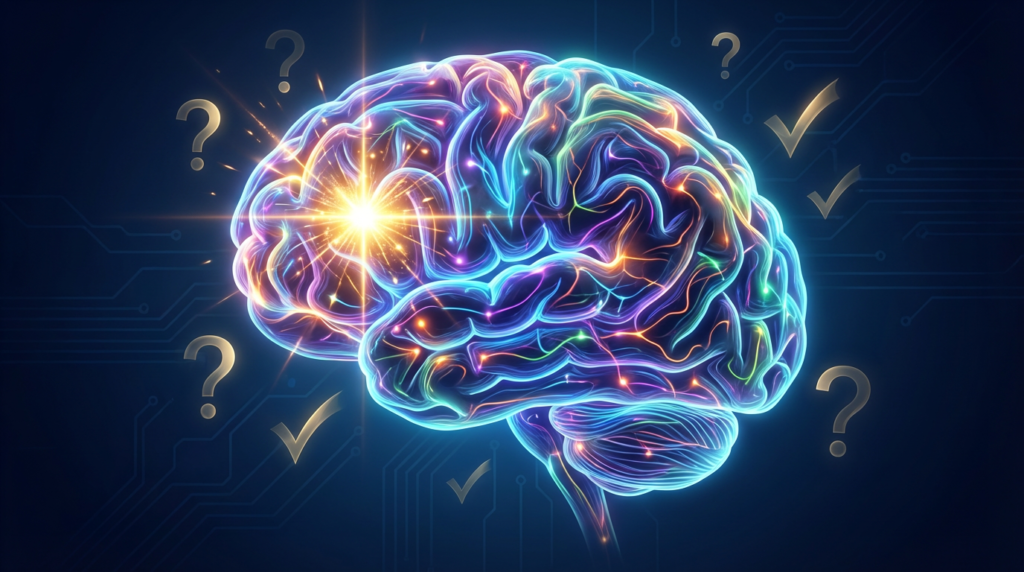
In that instant, a small, electric jolt of satisfaction courses through you. It’s a feeling of pure, unadulterated triumph. But what is that feeling? It’s not just pride or happiness. It’s a complex neurochemical event, a perfectly orchestrated symphony inside your brain. And the conductor of that symphony is a powerful neurotransmitter: dopamine.
Our deep, almost primal love for quizzes goes far beyond a simple desire for facts. It’s rooted in the fundamental wiring of our brains our need for reward, closure, and social validation. This article delves into the fascinating psychology of quizzes to uncover why that “Aha!” moment feels so incredibly good.
1. The Star of the Show: The Dopamine Reward System
At the heart of our love for quizzes is the brain’s reward system, and dopamine is its star player. Think of dopamine as your brain’s internal “like” button or a self-administered pat on the back. It’s a neurotransmitter associated with pleasure, motivation, and reward. Your brain releases it when you do something that it deems “good” or “beneficial” for survival, like eating delicious food, exercising, or achieving a goal.
When you answer a quiz question correctly, your brain interprets it as a successful completion of a task a small victory. In response, it releases a small burst of dopamine. This is the “dopamine hit” from the title. It’s a literal, physical reward that makes you feel happy, focused, and motivated to repeat the behaviour.
This is why quizzes are so addictive. Each correct answer creates a positive feedback loop: you answer a question, you get a dopamine reward, and so your brain craves another question in anticipation of the next reward. It’s a healthy, intellectually stimulating way to activate the same reward pathways that drive many of our most fundamental behaviours.
2. The Brain’s Tidiness Fetish: Seeking Closure and Order
Our brains are natural puzzle-solvers. They are wired to seek patterns, create order from chaos, and find solutions to problems. An unanswered question is, to our brain, an “open loop” an unresolved problem that creates a subtle form of cognitive tension. This phenomenon is related to the Zeigarnik effect, which states that we remember uncompleted tasks better than completed ones because they remain active in our minds.
A quiz question presents a perfectly structured micro-problem. When you hear the question, the loop opens. Your brain immediately gets to work, searching its vast database for the missing piece of information. The moment you find the answer (or learn it after getting it wrong), the loop closes.
This act of closing the loop is deeply satisfying. It provides a sense of completion, order, and control. In a world that is often chaotic and unpredictable, a quiz offers a series of small, solvable problems with clear, definitive answers. This provides a comforting sense of structure and predictability that our brains find incredibly appealing.
3. The Safe Arena: Low-Stakes Competition
Humans are inherently competitive. The desire to measure ourselves against others is a powerful motivator. However, real-world competition at work, in sports, or in relationships can be stressful and come with significant consequences. Failure can be painful.
A quiz provides the perfect solution: all the thrill of competition with almost none of the risk. It’s a safe arena where you can test your intellectual mettle against others in a friendly, low-stakes environment. The prize is rarely life-changing; it’s usually just bragging rights, a round of drinks, or the simple glory of being right.
This allows us to enjoy the stimulating and engaging aspects of competition without the associated anxiety. It encourages healthy rivalry and social bonding. Cheering for your team, debating an answer, and celebrating a victory together all strengthen social ties. The quiz transforms competition from a source of stress into a source of fun and connection.
4. The Mirror of the Mind: Reinforcing Our Self-Identity
Our sense of self is deeply tied to what we know and what we are passionate about. We build our identities around being “a history buff,” “a movie fanatic,” or “someone who keeps up with the news.” A quiz acts as a mirror, reflecting and validating that identity.
When a question comes up about your favorite topic and you know the answer, it’s more than just a point for your team. It’s a moment of self-affirmation. It reinforces your self-perception as a knowledgeable and interesting person. For example, we feel like an informed citizen when we correctly answer tricky current affair questions. This validation is deeply satisfying and boosts our self-esteem.
This is why a good quiz has variety. It gives everyone a chance to have their moment of expertise. The feeling of being the “hero” for your team, even for just one question, is a powerful social and psychological reward that makes us feel valued and seen.
5. The Joy of Effortless Learning
While the thrill of getting an answer right is powerful, the process of getting an answer wrong is just as important psychologically. When you guess an answer and the Quizmaster reveals the correct one, your brain experiences a small moment of surprise. This surprise element makes the new information highly memorable.
This is essentially “learning by stealth.” You are absorbing new facts and expanding your knowledge base without ever feeling like you’re studying or doing work. The process is gamified. The desire to win motivates you to pay attention, and the game-like format makes the information stick.
This explains why you can often remember a random fact you learned at a pub quiz years ago. The combination of social context, emotional engagement (the frustration of getting it wrong or the joy of learning something new), and the surprise element creates an incredibly effective learning environment. It’s a fun, almost effortless way to satisfy our brain’s innate curiosity.
Conclusion
Our love for quizzes is no accident. It is a perfect storm of positive psychological and neurological triggers. It taps into our brain’s fundamental desire for reward, our need for order and closure, our competitive spirit, our sense of identity, and our natural curiosity.
The satisfying “dopamine hit of being right” is the immediate reward, but the long-term benefits are even greater. Quizzing makes us more knowledgeable, improves our memory, reduces stress, and strengthens our social bonds. It’s a powerful reminder that learning and self-improvement don’t have to feel like work. Sometimes, they can be as simple, and as joyful, as a game of trivia with friends.
Frequently Asked Questions (FAQ)
1. Can this “dopamine hit” from quizzing become addictive?
While quizzing does activate the brain’s reward system, it is considered a healthy and constructive stimulation. Unlike harmful addictions, it doesn’t lead to negative life consequences. It’s a natural and positive way to engage the brain’s motivation and reward pathways.
2. Is it better to do quizzes alone or in a group?
Both have unique psychological benefits. Quizzing alone provides a pure, focused cognitive workout and personal satisfaction. Quizzing in a group adds a layer of social bonding, communication, and collaborative problem-solving, which is also incredibly rewarding.
3. What if I’m bad at quizzes and always get a low score?
The psychological benefits aren’t just for the winners. The act of trying to retrieve an answer (active recall) is beneficial even if you fail. Furthermore, every wrong answer is a prime opportunity for your brain to learn something new in a highly memorable way, which is a reward in itself.
4. Are certain types of quizzes more psychologically rewarding?
Quizzes that cover a topic you are passionate about will likely provide a bigger dopamine hit because they tap into your sense of identity. However, general knowledge quizzes are excellent for overall brain health as they force your brain to search a wider range of “files,” promoting cognitive flexibility.
5. How can I use this psychology to help me learn better?
You can “gamify” your own learning. Instead of just re-reading your notes, turn them into quiz questions. Use flashcard apps that test you. This forces you into active recall mode, which is one of the most effective study techniques ever discovered.