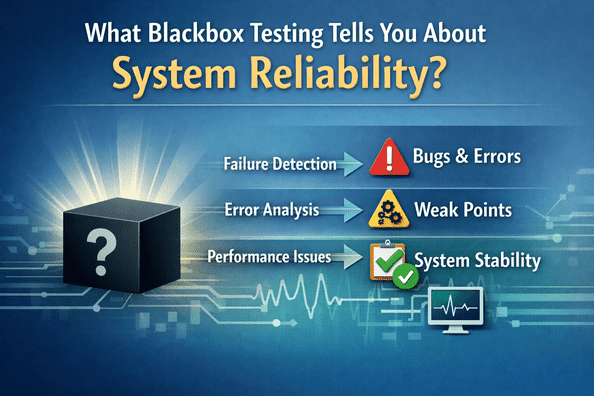

Reliability is one of the most critical qualities of modern software systems. Users expect applications to behave consistently, recover gracefully from failures, and deliver predictable outcomes under varying conditions. While code quality and architecture play an important role, true reliability can only be validated when a system is exercised as a whole.
This is where blackbox testing provides unique insight. By validating behavior without relying on internal implementation details, it reveals how reliably a system operates from the perspective that matters most—actual usage.
Understanding System Reliability Beyond Code
System reliability is not just about whether code compiles or individual functions behave correctly. It encompasses availability, consistency, error handling, and resilience under unexpected conditions.
Code reviews and unit tests help ensure correctness at the component level, but they cannot fully represent how the system behaves when dependencies fail, configurations drift, or real data flows through multiple layers. Blackbox testing helps bridge this gap by validating observable behavior rather than assumptions.
Validating Real Interaction Paths
One of the strongest signals of reliability comes from how a system handles real interaction paths. Blackbox testing executes workflows through public interfaces such as APIs or user-facing endpoints, closely mirroring production usage.
By exercising these paths, teams can observe whether requests are handled consistently, responses remain stable, and edge cases are managed predictably. This perspective is critical for identifying reliability issues that may not appear in isolated component tests.
Detecting Integration and Dependency Failures
Modern systems rely heavily on external services, databases, and message brokers. Even if internal code is correct, failures often originate at integration boundaries.
Blackbox testing validates how well a system handles partial failures, timeouts, and unexpected responses from dependencies. Reliable systems degrade gracefully under these conditions, while fragile ones surface errors inconsistently or fail completely.
These behaviors are difficult to reason about through code inspection alone, making blackbox testing a valuable reliability signal.
Observing Error Handling and Recovery Behavior
Reliability is closely tied to how systems respond to failure. Well-designed applications provide meaningful error responses, maintain consistency, and recover quickly.
Blackbox testing intentionally triggers invalid inputs, boundary conditions, and failure scenarios to observe system responses. It reveals whether errors are handled consistently and whether the system remains usable when something goes wrong.
This insight helps teams identify weaknesses in recovery logic that could otherwise remain hidden until production incidents occur.
Identifying Regression Risk Over Time
Reliability is not static. Changes introduced through new features, refactoring, or dependency upgrades can unintentionally alter system behavior.
Blackbox testing is especially effective at detecting regressions because it validates behavior across versions. When a previously stable interaction begins to fail, it often signals a reliability risk that needs immediate attention.
When integrated into CI/CD pipelines, blackbox testing provides continuous assurance that core workflows remain stable as the system evolves.
Measuring Stability Across Environments
A system may behave reliably in development but fail under production-like conditions. Differences in configuration, scale, and data often expose hidden issues.
Blackbox testing enables teams to validate behavior across environments without environment-specific assumptions. This helps identify configuration mismatches, missing dependencies, and environment-related failures before they impact users.
Consistent behavior across environments is a strong indicator of system reliability.
Complementing Automation and Monitoring
While monitoring provides real-time visibility into production behavior, blackbox testing offers proactive validation before issues reach users. Together, they form a strong reliability strategy.
Some teams enhance this approach by using tools like Keploy to capture real API traffic and convert it into automated blackbox tests. This allows teams to validate reliability using real-world scenarios, increasing confidence that tests reflect actual usage patterns.
Interpreting Reliability Signals Correctly
It is important to interpret results from blackbox testing in context. A failure does not always indicate a defect; it may reveal unclear requirements, undocumented behavior, or missing error handling.
Reliable systems are not those that never fail, but those that fail predictably and transparently. Blackbox testing helps teams evaluate whether failures align with expectations and user needs.
Final Thoughts
System reliability cannot be fully assessed by examining code alone. It requires validating how the system behaves under real conditions, with real interactions and real failures.
By focusing on observable behavior, blackbox testing provides valuable insight into stability, resilience, and regression risk. When used consistently alongside automation and CI/CD practices, it becomes a powerful tool for building and maintaining reliable software systems.